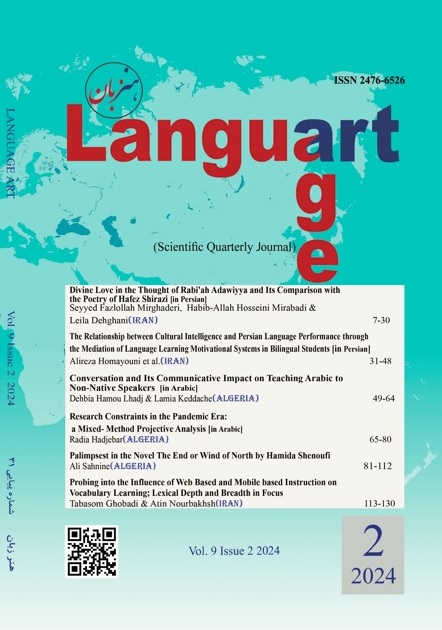
Probing into the Influence of Web Based and Mobile based Instruction on Vocabulary Learning; Lexical Depth and Breadth in Focus
DOI:
https://doi.org/10.22046/LA.2024.12Keywords:
Web and Mobile based Instruction, Vocabulary Learning, Lexical Knowledge, Lexical Depth, Lexical BreadthAbstract
This study investigated the effects of web-based and mobile-assisted instruction on Iranian EFL learners’ lexical depth and breadth. Out of 150 learners, 120 intermediate participants were selected through an Oxford Placement Test and randomly assigned to three equal groups: one receiving web-based instruction, one taught through Mobile-Assisted Language Learning (MALL), and a control group receiving traditional instruction. Prior to the treatment, a vocabulary pretest was administered to all groups. The instructional intervention lasted for eight sessions, during which the web-based group used online vocabulary learning programs and the MALL group received instruction via a mobile application. The control group was taught through conventional classroom methods. A posttest was then administered to measure the impact of the treatments. Data were analyzed using ANCOVA. The findings revealed that both web-based and mobile-assisted instruction significantly enhanced learners’ lexical depth and breadth compared with the traditional method. Moreover, no statistically significant difference was observed between the effects of the two technology-enhanced instructional modes. Pedagogical and theoretical implications are discussed.
References
Akhlaghi, M., & Zareian, M. (2015). The effect of using vocabulary teaching software on Iranian EFL learners' vocabulary acquisition. International Journal of Research Studies in Educational Technology, 4(1), 55–68.
Alrasheedi, M., & Capretz, L. F. (2018). A meta-analysis of critical success factors affecting mobile learning. IEEE Transactions on Education, 61(3), 221–230.
Altiner, C. (2019). The effect of web-based language learning on vocabulary acquisition (Unpublished doctoral dissertation). University of Arizona.
Anderson, R. C. (2018). The role of vocabulary knowledge in reading comprehension. In The Routledge handbook of vocabulary studies (pp. 127–140). Routledge.
Barjesteh, H., Movafaghardestani, E., & Modaberi, A. (2022). COVID-19’s impact on digitalization of education: Incorporating visual vocabulary learning application to foster vocabulary knowledge. Asian Education and Development Studies, 11(1), 172–187.
Bootchuy, T. (2019). The use of technology in English language teaching in Thailand. Journal of Education and Practice, 10(12), 44–49.
Cavus, N., & Ibrahim, D. (2009). M-learning: An experiment in using SMS to support learning new English language words. British Journal of Educational Technology, 40(1), 78–91.
Chung, H. (2006). A study of using mobile phones in the English language learning of Taiwanese vocational high school students (Unpublished master’s thesis). National Taiwan Normal University, Taipei, Taiwan.
Cucinotta, D., & Vanelli, M. (2020). WHO declares COVID-19 a pandemic. Acta Bio-Medica: Atenei Parmensis, 91(1), 157–160.
Ellis, N. C. (2016). Salience, cognition, and complexity. In Salience in second language acquisition (pp. 59–86). Routledge.
Elumalai, K. V., Sankar, J. P., Kalaichelvi, R., John, J. A., Menon, N., Alqahtani, M. S. M., & Abumelha, M. A. (2021). Factors affecting the quality of e-learning during the COVID-19 pandemic from the perspective of higher education students. Journal of Information Technology Education: Research, 19, 731–753.
Frohberg, D., Göth, C., & Schwabe, G. (2009). Mobile learning projects: A critical analysis of the state of the art. Journal of Computer Assisted Learning, 25(4), 307–331.
Ghabanchi, Z., & Anbarestani, M. (2008). The effects of CALL program on expanding lexical knowledge of EFL Iranian intermediate learners. Reading Matrix: An International Online Journal, 8(2), 86–99.
Gharehblagh, N. M., & Nasri, N. (2020). Developing EFL elementary learners' writing skills through mobile-assisted language learning (MALL). Teaching English with Technology, 20(1), 104–121.
Gilakjani, A. P., Leong, L. M., & Sabouri, N. B. (2013). Teachers’ use of technology and constructivism. International Journal of Modern Education and Computer Science, 5(4), 49–63.
Godwin, R. (2018). The impact of mobile learning on student engagement and achievement. Journal of Educational Technology Systems, 47(2), 154–169.
Gonulal, T. (2019). The use of Instagram as a mobile-assisted language learning tool. Contemporary Educational Technology, 10(3), 309–323.
Greeno, J. G. (1996). Cognition and learning. In R. C. Calfee & D. C. Berliner (Eds.), Handbook of educational psychology (pp. 15–46). Routledge.
Gromik, N. A. (2012). Cell phone video recording feature as a language learning tool: A case study. Computers & Education, 58(1), 223–230.
Heafner, T. L. (2018). Blended learning and the development of student self-regulation. In J. M. Spector, B. B. Lockee, & M. D. Childress (Eds.), Learning, design, and technology (pp. 1–23). Springer.
Hwang, G. J., & Tsai, C. C. (2011). Research trends in mobile and ubiquitous learning: A review of publications in selected journals from 2001 to 2010. British Journal of Educational Technology, 42(4), E65–E70.
International Telecommunication Union. (2015). ICT facts and figures 2015. ITU.
John-Steiner, V., & Mahn, H. (1996). Sociocultural approaches to learning and development: A Vygotskian framework. Educational Psychologist, 31(3–4), 191–206.
Khazaei, Z. M., & Dastjerdi, H. V. (2010). A comparative study of the effect of online and traditional teaching on EFL students’ vocabulary learning. English Language Teaching, 3(2), 205–210.
Kocoglu, Z. (2008). Using mobile phones in language learning: A review of the literature. Journal of Educational Technology & Society, 11(3), 308–319.
Krisbiantoro, B., & Pujiani, T. (2021). The effectiveness of MALL vs. flipped classroom on EFL students’ writing skill. Journal on English as a Foreign Language, 11(2), 291–315.
Kukulska-Hulme, A., & Shield, L. (2017). An overview of mobile-assisted language learning: From content delivery to supported collaboration and interaction. ReCALL, 20(3), 271–289.
Kvavik, R. B. (2005). Convenience, communications, and control: How students use technology. In D. G. Oblinger & J. L. Oblinger (Eds.), Educating the net generation (pp. 7.1–7.20). EDUCAUSE.
Lee, J. S. (2021). The role of technology in language learning motivation. System, 103, 102647.
Li, J., & Cummins, J. (2019). Effect of using texting on vocabulary learning: A meta-analysis. Journal of Educational Computing Research, 57(4), 1042–1070.
Lin, C. P., & Ju, Y. M. (2013). Applying social constructivism to online learning. Journal of Educational Technology & Society, 16(4), 226–237.
Liu, M., & Chen, H. (2010). A study of the application of constructivist theory in web-based instruction. Journal of Educational Technology Development and Exchange, 3(1), 43–50.
Miangah, T. M., & Nezarat, A. (2012). Mobile-assisted language learning. International Journal of Distributed and Parallel Systems, 3(1), 309–319.
Motiwalla, L. F. (2007). Mobile learning: A framework and evaluation. Computers & Education, 49(3), 581–596.
Naraghizadeh, M., & Barimani, S. (2020). The effect of CALL on vocabulary learning of Iranian EFL learners. Journal of Language and Translation, 10(1), 49–59.
Nation, I. S. P. (1983). Teaching and learning vocabulary. University of Wellington.
Nation, I. S. P. (1993). Using dictionaries to estimate vocabulary size: Essential, but rarely followed, procedures. Language Testing, 10(1), 27–40.
Nation, I. S. P. (2011). Researching vocabulary: A vocabulary research manual. Palgrave Macmillan.
Norazah, M. N., Rafiza, A. R., & Rosseni, D. (2010). The role of technology in applying learning theories in the classroom. Procedia - Social and Behavioral Sciences, 2(2), 2779–2783.
Oblinger, D. G. (2005). Learners, learning, and technology: The EDUCAUSE learning initiative. EDUCAUSE Review, 40(5), 66–75.
Ouyang, J. R., & Stanley, N. (2014). Theories and research in educational technology and distance learning instruction through Blackboard. Universal Journal of Educational Research, 2(2), 161–172.
Pachler, N., Bachmair, B., & Cook, J. (2010). Mobile learning: Structures, agency, practices. Springer.
Philips, D. (2018). Longman complete course for the TOEFL test. Pearson Education.
Qian, D. D. (2002). Investigating the relationship between vocabulary knowledge and academic reading performance: An assessment perspective. Language Learning, 52(3), 513–536.
Qian, D. D. (2019). Vocabulary knowledge and reading comprehension revisited: A structural equation modeling study. Language Testing, 36(4), 491–516.
Read, J. (1993). The development of a new measure of L2 vocabulary knowledge. Language Testing, 10(3), 355–371.
Read, J. (2019). Assessing vocabulary in a second language. In The Routledge handbook of vocabulary studies (pp. 471–486). Routledge.
Read, J., Dang, T. N. Y., & Ngu, B. T. (2013). Vocabulary assessment: What we know and what we need to learn. Language Teaching, 46(1), 45–63.
Sampson, D. G. (2021). Digital technologies for transforming learning. Educational Technology & Society, 24(1), 1–3.
Schcolnik, M., Kol, S., & Abarbanel, J. (2006). Constructivism in theory and in practice. English Teaching Forum, 44(4), 12–20.
Schmidt, N., et al. (2001). A new vocabulary levels test. Language Testing, 18(1), 55–88.
Seno, M., Basuki, A., Wijaya, H., & Setiawan, A. (2009). The potential of mobile learning for ubiquitous learning environments. Journal of Educational Technology & Society, 12(3), 212–225.
Solak, E., & Cakir, R. (2015). Language learning with mobile technologies: An overview of the field. Procedia - Social and Behavioral Sciences, 191, 1726–1731.
Son, J. B. (2018). Teacher development in technology-enhanced language teaching. Palgrave Macmillan.
Son, J. B., & O’Neill, S. (1999). Using the web for language learning and teaching. ON-CALL, 13(2), 24–31.
Sung, Y. T., Chang, K. E., & Yang, J. M. (2016). How effective are mobile devices for language learning? A meta-analysis. Educational Research Review, 16, 68–84.
Taj, I. H., Sulan, N. B., & Sipra, M. A. (2016). Impact of mobile assisted language learning (MALL) on EFL: A meta-analysis. Advances in Language and Literary Studies, 7(2), 76–83.
Thornton, P., & Houser, C. (2005). Using mobile phones in English education in Japan. Journal of Computer Assisted Learning, 21(3), 217–228.
Vygotsky, L. S. (1978). Mind in society: The development of higher psychological processes. Harvard University Press.
Wong, L. H., & Looi, C. K. (2010). Vocabulary learning by mobile-assisted authentic content creation and social meaning-making: Two case studies. Journal of Computer Assisted Learning, 26(5), 421–433.
Xodabande, I., & Hashemi, M. R. (2023). Learning English with electronic textbooks on mobile devices: Impacts on university students' vocabulary development. Education and Information Technologies, 28(2), 1587–1611.
Yetis, V. S. (2010). The effect of web-based instruction on vocabulary learning. Journal of Language and Linguistic Studies, 6(2), 1–16.
Zhang, B., Song, W., & Liu, H. (2010). The comparative effect of computer-assisted language learning (CALL) and traditional methods on Chinese EFL learners’ vocabulary retention. Journal of Language Teaching and Research, 1(6), 794–803.
Downloads
Published
How to Cite
Issue
Section
License
Copyright (c) 2024 Tabasom Ghobadi

This work is licensed under a Creative Commons Attribution 4.0 International License.