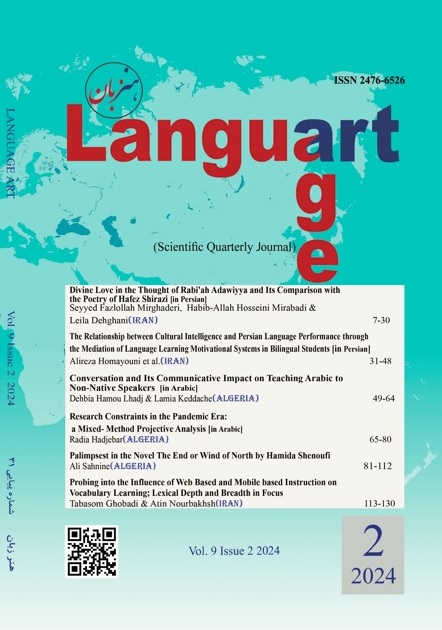
The Relationship between Cultural Intelligence and Persian Language Performance through the Mediation of Language Learning Motivational Systems in Bilingual Students
DOI:
https://doi.org/10.22046/LA.2024.08Keywords:
Cultural Intelligence, Motivational System of Persian Language Learning, Persian Language Performance, Bilingual StudentsAbstract
The purpose of the present study was to investigate the relationship between cultural intelligence with Persian language performance through the mediation of language learning motivational systems in Turkman bilingual students. The research method is of correlation type using structural equation modeling and the statistical population of the research was bilingual Turkmen secondary school students, according to the number of observed variables and the coefficient of 12 and including incomplete questionnaires, 206 people were selected as the sample size and answered Ang & Early’s (2004) cultural intelligence questionnaire, Khaleghizadeh et al’s (2019) motivation to learn Persian language questionnaire. Also, the scores of students' Persian language course at the end of the semester were used to measure the variable of Persian language performance. Data analysis was done with structural equation method and SPSS 18 and Amos 23 software. The results showed that there was a positive correlation between cultural intelligence and the motivational system of Persian language learning with Persian language performance in students. According to the standardized values (β), the mediating role of the motivational system of Persian language learning in the relationship between cultural intelligence and Persian language performance was confirmed.
References
Ang, S., Van Dyne, L., Koh, C., & Ng, K. Y. (2004, August). The measurement of cultural intelligence. In academy of management meetings symposium on cultural intelligence in the 21st century, New Orleans, LA (Vol. 214).
Ang, S., & Van Dyne, L. (2008). Conceptualization of cultural intelligence: Definition, distinctiveness, and nomological network. Handbook of cultural intelligence: Theory, measurement, and applications, 1, 3-15.
Ang, S., Van Dyne, L., Koh, C., Ng, K. Y., Templer, K. J., Tay, C., & Chandrasekar, N. A. (2007). Cultural intelligence: Its measurement and effects on cultural judgment and decision making, cultural adaptation and task performance. Management and organization review, 3(3), 335-371.
Bagheri Nevisi, R., & Alasadi, Z. (2022). Investigating cultural intelligence and emotional intelligence as predictors of burnout among Iraqi EFL teachers. Journal of Language Horizons, 6(1), 73-92.
Bücker, J. J., Furrer, O., Poutsma, E., & Buyens, D. (2014). The impact of cultural intelligence on communication effectiveness, job satisfaction and anxiety for Chinese host country managers working for foreign multinationals. The International Journal of Human Resource Management, 25(14), 2068-2087.
Dörnyei, Z. (2005). The Psychology of the Language Learner: Individual Differences in Second Language Acquisition. Lawrence Erlbaum Associates Publishers.
Dörnyei, Z., & Ushioda, E. (Eds.). (2009). Motivation, language identity and the L2 self (Vol. 36). Multilingual Matters.
Earley, P. C., & Ang, S. (2003). Cultural intelligence: Individual interactions across cultures. Stanford University Press.
Ghonsooly, B., & Shalchy, S. (2013). Cultural intelligence and writing ability: Delving into fluency, accuracy and complexity. Novitas-ROYAL (Research on Youth and Language), 7(2): 147-159.
Kormos, J., & Dörnyei, Z. (2004). The interaction of linguistic and motivational variables in second language task performance. Zeitschrift für interkulturellen Fremdsprachenunterricht, 9(2) 1-19.
Mohammed, I. J., & Al-Bakri, S. A. (2022). Iraqi EFL University Students' Cultural Intelligence and Language Proficiency: A Correlational Study. Journal of Language Studies. Vol, 5(3), 56-65.
Moshabaki, A., & Tizro, A. (2020). Emotional and Cultural Intelligences Factors of Global Leadership Success. Commercial Strategies, 8(44), 237-250.
Özkaynak, O. (2020). A structural equation model on translanguaging practices, foreign language classroom anxiety, reconceptualized L2 motivational self system, and foreign language achievement of emergent bilinguals (Doctoral dissertation, Bilkent University).
Presbitero, A., & Attar, H. (2018). Intercultural communication effectiveness, cultural intelligence and knowledge sharing: Extending anxiety-uncertainty management theory. International Journal of Intercultural Relations, 67, 35-43.
Rachmawaty, N., Wello, M. B., Akil, M., & Dollah, S. (2018). Do Cultural Intelligence and Language Learning Strategies Influence Students' English Language Proficiency? Journal of Language Teaching and Research, 9(3), 655-663.
Reeve, J. (2018). Understanding motivation and emotion. John Wiley & Sons.
Shyr, W. J., Feng, H. Y., Zeng, L. W., Hsieh, Y. M., & Shih, C. Y. (2017). The relationship between language learning strategies and achievement goal orientations from Taiwanese engineering students in EFL learning. Eurasia Journal of Mathematics, Science and Technology Education, 13(10), 6431-6443.
Tanielian, A. R. (2014). Foreign language anxiety in a new English program in Thailand. International Education Journal: Comparative Perspectives, 13(1), 60-81.
Van Dyne, L., Ang, S., & Livermore, D. (2010). Cultural intelligence: A pathway for leading in a rapidly globalizing world. Leading across differences, 4(2), 131-138.
Yuan, Z. (2018, July). A Study on the Relationship Between English Learning Anxiety and L2 Motivational Self-system Among Chinese College Students. In 4th International Conference on Arts, Design and Contemporary Education (ICADCE 2018). Atlantis Press.
Azaripanah, L. (2008). Motivation in learning Persian as a second language among Azeri-speaking female students [Master's thesis]. Payame Noor University.
Ettar Sharghi, N. (2019). Comparing arousal levels and motivational factors in Chinese and Lebanese Persian learners. Journal of Teaching Persian to Speakers of Other Languages, 8(2), 93-117.
Ettar Sharghi, N., & Akbari, B. (2020). Motivational factors in Persian language learning. Journal of Teaching Persian to Speakers of Other Languages, 9(2), 65-86.
Ezzami, S. M., & Kihan, J. (2018). Identity styles and academic help-seeking among non-native students. Farhang Dar Daneshgah-e Eslami, 8 (26), 107-128.
Brahui Moghaddam, N. (2020). Strategies for improving language readiness in bilingual regions. Quarterly Journal of Educational Research, 6(21), 118-130.
Hassanzadeh, F., Homayouni, A., Sadeghi, J., & Akbarnatij, N. (2022). L2 motivational self-system and personality traits. Biannual Journal of Psychological Studies of Adolescents and Youth, 3(3), 140-149.
Khaleghizadeh, Sh., Pahlavannejad, M. R., Vakilifard, A. R., & Kamiabi Gol, A. (2020). Validation of Persian language motivation questionnaire. Journal of Teaching Persian to Speakers of Other Languages, 9(2), 20-63.
Khodadadian, M., & Abtahi, M. (2016). Cultural intelligence and Persian language skills. Journal of Teaching Persian to Speakers of Other Languages, 5(12), 123-142.
Khadivi, A., & Vakili Mofakhkham, A. (2011). Achievement motivation and academic performance. Quarterly Journal of Education and Evaluation, 4(13), 45-66.
Raqibdust, Sh., & Asgharpour Masouleh, M. (2009). Reading motivation and comprehension in non-Persian learners. Biannual Journal of Linguistics, 1(1), 51-72.
Zare Marzouni, M., Homayouni, A., Mohammadzadeh Admolaei, R., & Barjasteh, H. (2022). Modeling English motivational selves with language anxiety. Bimonthly Journal of Medical Education Strategies, 15(3), 233-241.
Sadi Pour, E., Malaei, Z., & Vakilifard, A. R. (2017). Developing motivational self-system model for Persian learners. Research in Educational Systems, 11(37), 37-58.
Abbasiyan, F. (2013). Cultural intelligence and communicative competence [Master's thesis]. Ferdowsi University.
Abdollahi, F., & Homayouni, A. (2019). Predicting language learning motivation. Biannual Journal of Cultural Psychology, 3(2), 17-32.
Ghaderi, B. (2012). Motivation and achievement in non-Persian learners [Master's thesis]. Allameh Tabataba'i University.
Karimi, A. (2015). Intercultural understanding and school attitudes. Journal of Teaching Persian to Speakers of Other Languages, 4(9), 28-30.
Mahmoudi, H., Mostafalou, T., Abdollahi, J., & Pournaseh, S. (2017). Effectiveness of cultural intelligence training. Journal of Cultural Psychology, 1(2), 113-131.
Homayouni, A., Abdollahi, M. H., Hashemi, S., Farzad, V., & Dortaj, F. (2022). Language anxiety as mediator. Quarterly Journal of Psychological Models and Methods, 13(49), 43-54.
Downloads
Published
How to Cite
Issue
Section
License
Copyright (c) 2024 Alireza Homayouni, قدسیه ابراهیم پور , سید جلال عبدالمنافی رکنی, منوچهر بابانژاد, علیرضا سنگانی

This work is licensed under a Creative Commons Attribution 4.0 International License.